
Introduction
Mortgage documents are often treated as routine paperwork—signed, filed, and rarely revisited. Yet, hidden within these pages can be errors, inconsistencies, and even legal violations that affect both homeowners and investors. This is where a mortgage securities audit report becomes highly relevant. It isn’t just a technical review; it’s a detailed examination that can reveal whether a mortgage was handled correctly from the beginning.
Over the past decade, more borrowers and financial professionals have started paying closer attention to these audits. Why? Because mortgage securitization—the process of bundling loans and selling them to investors—can introduce layers of complexity. If something goes wrong during that process, the consequences can be significant. Missing assignments, incorrect documentation, or compliance failures are not rare—they’re often overlooked.
A properly conducted audit helps uncover these issues. It looks at how the loan was originated, transferred, and managed. For homeowners, this can mean identifying potential legal defenses. For investors, it offers clarity on the quality and integrity of the asset.
At Mortgage Audits Online, professionals specialize in reviewing mortgage records with precision. Their goal is simple: to provide clear, factual insights that empower clients to make informed decisions. Whether you’re dealing with foreclosure concerns or reviewing investment risks, understanding your audit report is the first step toward taking control of your financial position.
What Is a Mortgage Securities Audit Report?
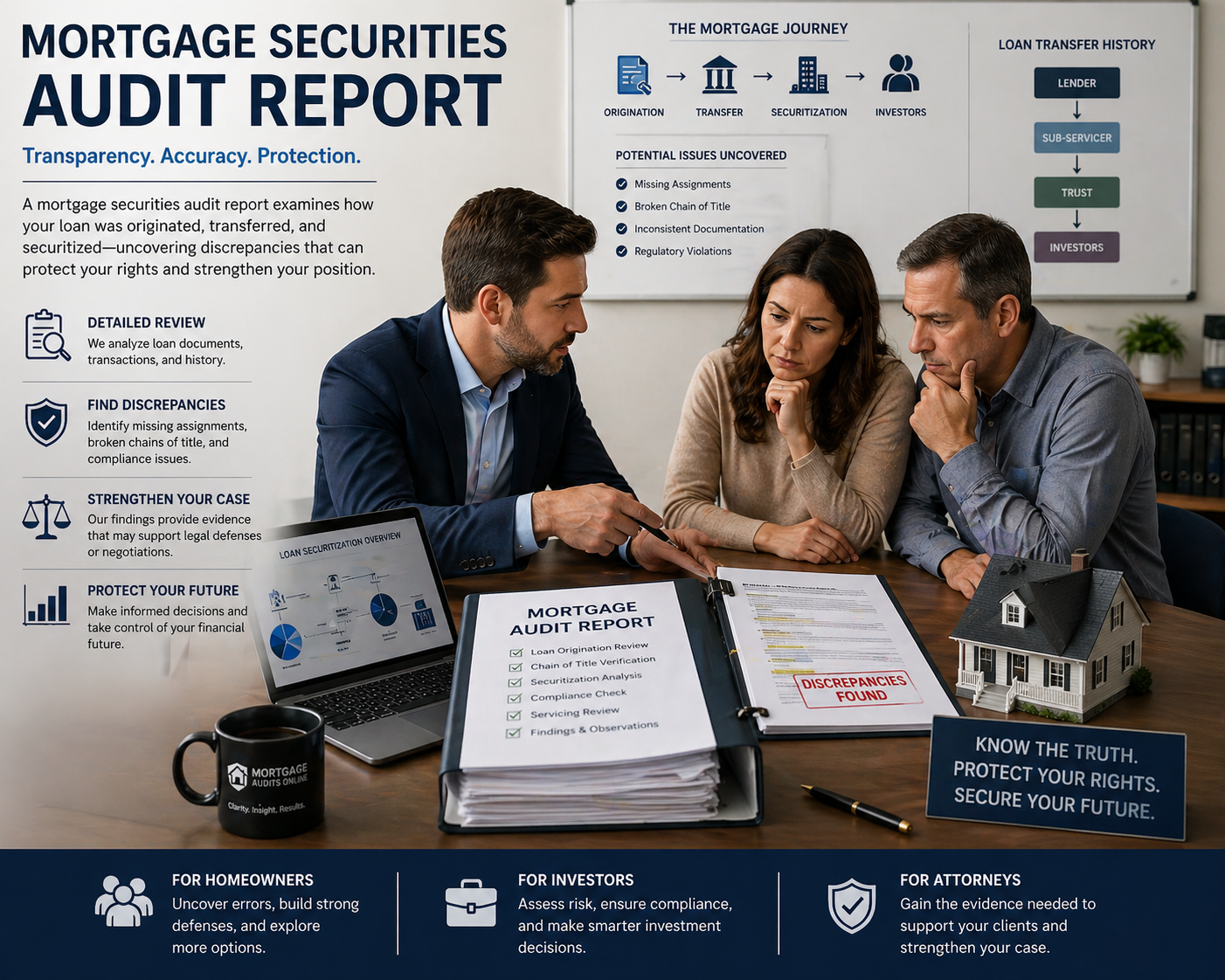
A mortgage securities audit report is a structured review of loan documents, securitization history, and compliance with federal and state laws. It examines whether the mortgage followed proper procedures from origination to its placement in a trust or investment pool.
The audit typically covers:
- Loan origination accuracy
- Chain of title verification
- Compliance with lending regulations
- Securitization details and trust placement
- Servicing practices and payment records
This type of report is not just for legal professionals. Borrowers facing financial stress often use it to better understand their situation.
Why the Mortgage Securities Audit Report Matters
Mortgage errors can have long-term consequences. A small documentation issue today could affect foreclosure proceedings or loan modifications tomorrow. The mortgage securities audit report helps identify such issues early.
It offers:
- Transparency into complex loan structures
- Evidence that may support legal claims
- A clearer understanding of lender practices
- Insight into investor risk exposure
In many cases, borrowers discover discrepancies they were never aware of—missing endorsements, incorrect transfers, or violations of trust agreements.
Common Mistakes
Many borrowers assume their mortgage records are flawless. Unfortunately, that’s rarely the case. Some of the most frequent mistakes include:
- Incomplete Documentation: Missing signatures or endorsements
- Broken Chain of Title: Gaps in ownership transfer history
- Incorrect Loan Terms: Discrepancies between original agreement and recorded data
- Regulatory Violations: Non-compliance with lending laws
Ignoring these issues can limit your options later. An audit brings them to light before they become bigger problems.
Real Story
A homeowner in Texas believed their foreclosure was unavoidable. After ordering an audit through Mortgage Audits Online, they discovered that their loan had never been properly transferred into the securitized trust.
This single detail changed everything. Their legal team used the findings to challenge the foreclosure process, buying valuable time and opening the door for negotiation.
Stories like this are not unusual. They highlight how critical accurate documentation is in mortgage transactions.
Practical Tips
If you’re considering a mortgage audit, keep these points in mind:
- Gather All Documents: Include loan agreements, payment records, and correspondence
- Act Early: Don’t wait until foreclosure proceedings begin
- Work With Experts: Professional audits provide deeper insights than DIY reviews
- Understand the Findings: Take time to review the report thoroughly
Being proactive can make a significant difference in outcomes.
Expert Advice
Professionals at Mortgage Audits Online recommend focusing on clarity rather than assumptions. Many borrowers assume their lender followed every rule, but audits often reveal otherwise.
Experts suggest:
- Reviewing your loan annually
- Keeping organized records
- Consulting legal professionals when discrepancies appear
- Using audit reports as informational tools, not just legal weapons
A well-prepared borrower is always in a stronger position.
Testimonials
Michael R., Florida
“I had no idea my mortgage had errors until I saw the audit report. It gave me a completely new perspective.”
Sarah L., California
“The team explained everything clearly. I finally understood what was happening with my loan.”
David P., New York
“The audit helped my attorney build a stronger case. It was worth every penny.”
Angela W., Illinois
“I felt overwhelmed before the audit. Now I feel informed and prepared.”
Kevin T., Arizona
“Professional, detailed, and easy to understand. Highly recommended.”
How to Decode a Mortgage Securities Report for Smarter Financial Decisions
Understanding a mortgage report can feel overwhelming, especially when technical terms and legal language dominate the document. A mortgage securities report is no exception. It’s detailed, data-heavy, and often misunderstood by those who need it most.
Yet, this report holds valuable insights. It reveals how a mortgage was structured, transferred, and managed over time. For borrowers, this can uncover potential errors or inconsistencies. For investors, it offers a deeper look into asset quality and compliance.
At Mortgage Audits Online, the focus is on making these reports accessible and meaningful. Instead of leaving clients confused, their approach emphasizes clarity and practical application. Because a report is only useful if you can understand and act on it.
Common Mistakes
Even experienced borrowers make errors when reviewing mortgage reports:
- Skipping technical sections
- Misinterpreting legal terminology
- Ignoring securitization details
- Overlooking servicing discrepancies
These mistakes can lead to missed opportunities for action.
Real Story
An investor reviewing a mortgage-backed security noticed irregularities in payment flows. With help from an audit report, they identified servicing inconsistencies that affected returns. This allowed them to adjust their investment strategy and avoid further losses.
Practical Tips
To get the most from your report:
- Read it in sections rather than all at once
- Highlight unfamiliar terms and research them
- Compare findings with original loan documents
- Seek professional guidance if needed
Understanding grows step by step.
Expert Advice
Experts suggest focusing on patterns rather than isolated issues. One small discrepancy may not matter, but multiple inconsistencies often signal deeper problems.
They also recommend using the report as a planning tool—whether for legal action, refinancing, or investment decisions.
Conclusion
A mortgage securities report is more than a document—it’s a window into the true state of a loan. When understood properly, it can guide better decisions, reduce risks, and uncover opportunities that might otherwise remain hidden.
What many borrowers don’t realize is that mortgage transactions are rarely as simple as they appear on the surface. Loans often pass through multiple entities, and each transfer introduces the possibility of error. A detailed report helps trace that journey, bringing clarity to what is otherwise a confusing process. It allows you to see not just where your loan stands today, but how it got there—and whether every step followed proper procedures.
For homeowners, this knowledge can be empowering. It can shift the conversation from uncertainty to informed action, especially when dealing with lenders or legal representatives. For investors, it offers a clearer picture of risk, helping them make more calculated decisions rather than relying on assumptions.
Working with experienced professionals, such as the team at Mortgage Audits Online, ensures that the findings are not only accurate but also explained in a way that makes sense. Ultimately, the value of a mortgage securities report lies in its ability to turn complex data into meaningful insight—insight that supports smarter, more confident financial choices over time.
FAQ
Q1: Who should get a mortgage securities report?
Homeowners, investors, and legal professionals can all benefit from it.
Q2: Is it only useful during foreclosure?
No, it’s valuable at any stage of a loan.
Q3: How long does an audit take?
Typically a few days to a couple of weeks, depending on complexity.
Q4: Can it guarantee legal success?
No, but it provides strong supporting evidence.
Q5: Why choose Mortgage Audits Online?
They focus on accuracy, clarity, and actionable insights.
Testimonials
Author’s Bio
Daniel Harper is a U.S.-based financial analyst specializing in mortgage compliance, securitization analysis, and forensic loan auditing. With over 12 years of hands-on experience in the mortgage and financial services industry, he has worked closely with homeowners, attorneys, and institutional investors to break down complex loan structures into clear, actionable insights. His work focuses on identifying documentation gaps, compliance issues, and securitization irregularities that often go unnoticed in standard loan reviews.
Daniel has contributed to numerous case evaluations involving foreclosure defense and mortgage dispute resolution, offering research-backed perspectives that support informed decision-making. He is known for translating highly technical audit findings into practical guidance that clients can actually use—whether they are preparing for legal proceedings, exploring loan modification options, or reviewing investment risks.
In collaboration with Mortgage Audits Online, Daniel continues to publish educational content aimed at improving financial awareness and transparency in the lending space. His approach is grounded in accuracy, clarity, and real-world relevance, making his insights valuable for both industry professionals and everyday borrowers seeking to better understand their mortgage position.